A shingle project can get expensive fast when the measurements are off. Order too little, and the job stalls halfway through. Order too much, and you waste money on materials you did not need. That is why homeowners often start with one practical question: how to measure my roof for shingles.
The good news is that the basic process is not complicated. The hard part is getting a number that is close enough to be useful without missing roof pitch, valleys, dormers, and waste. If you want a rough material estimate, you can do it yourself. If you want an exact number for a replacement project, a roofer should still confirm it in person.
How to Measure My Roof for Shingles: Quick Answer
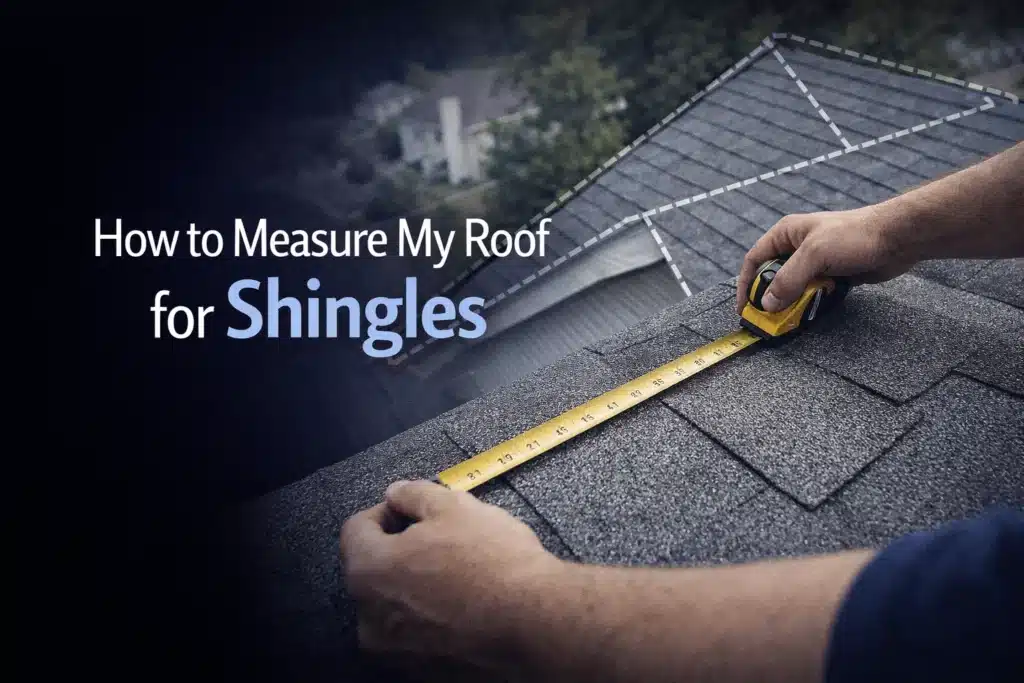
How to measure my roof for shingles starts with calculating the square footage of each roof section. Measure the length and width of every plane, multiply those numbers, add all sections together, then adjust for roof pitch and waste. After that, divide the total by 100 to get the number of roofing squares.
As we often explain to homeowners, the simple number from a flat measurement is only the starting point. A roof with steep pitch, hips, valleys, dormers, cut-up sections, or complex lines usually needs more shingles than a basic rectangle.
What You Need Before Measuring a Roof for Shingles
Before you start, keep the goal clear. Most homeowners are measuring for one of two reasons. They either want a rough idea of material needs or they are trying to estimate the cost of a new shingle roof.
For a rough estimate, basic measurements can help. For an exact material order, especially on a replacement job, a professional roof inspection or contractor measurement is the safer path. Roof shape, decking issues, edge detail, and waste percentage can all change the final number.
Basic tools that help
You do not need a long list of gear to get started. In most cases, these are enough:
- tape measure or laser measure
- ladder if safe to use
- notebook or phone notes
- calculator
- graph paper for sketching roof sections
If the roof is steep, damaged, wet, or hard to access, do not climb it. Ground-based estimates or attic-based measurements are safer than risking a fall.
Know what a roofing square means
Roofing materials are often priced and estimated in squares. One roofing square equals 100 square feet of roof area.
So if your roof measures 2,400 square feet after pitch adjustment, that equals 24 squares of shingles before adding waste.
Step 1: Break the Roof Into Simple Sections
Most roofs are not one perfect rectangle. The easiest way to measure them is to sketch the roof and break it into basic shapes like rectangles, triangles, and trapezoids.
This makes the math much easier. It also helps you avoid missing smaller sections over garages, porches, dormers, or additions.
Keep each roof plane separate
Measure each plane on its own instead of trying to guess the whole roof at once. For example, front slope, back slope, garage slope, and porch slope should all be listed separately.
That matters because different sections may have different sizes, different pitch, or extra cuts that affect waste.
Label your sketch clearly
Write the dimensions directly on the drawing. It is much easier to review later if every section is labeled clearly instead of scattered across random notes.
Even a rough hand sketch is enough if the measurements are readable.
Step 2: Measure Length and Width of Each Section
For each roof section, measure the length and width. Then multiply those two numbers to get the square footage of that section.
Example:
- section A = 30 ft × 20 ft = 600 sq ft
- section B = 15 ft × 12 ft = 180 sq ft
Add those together after you measure every section.
Use the home footprint if roof access is limited
If walking the roof is not safe, many homeowners use exterior home dimensions as a rough guide. That can work for simple gable roofs, but it becomes less accurate once overhangs, pitch, and complex shapes enter the picture.
This is one reason a professional roof inspection is often worth it before a major replacement decision.
Do not forget overhangs
Roof edges usually extend beyond the wall line. If you measure only the home’s footprint and ignore overhangs, your estimate may come in short.
Even a small overhang around the house can add up over the full roof.
Step 3: Add All Roof Sections Together
Once each plane has its own square footage, add them all to get the total flat area.
Here is a simple example:
| Roof Section | Measurement | Area |
| Front slope | 30 × 20 | 600 sq ft |
| Back slope | 30 × 20 | 600 sq ft |
| Garage slope | 15 × 12 | 180 sq ft |
| Porch slope | 10 × 8 | 80 sq ft |
Flat total = 1,460 square feet
That flat total gives you a base number, but it still does not account for pitch.
Takeaway:
If you stop here, the number may look reasonable, but it can still be too low for actual shingle ordering.
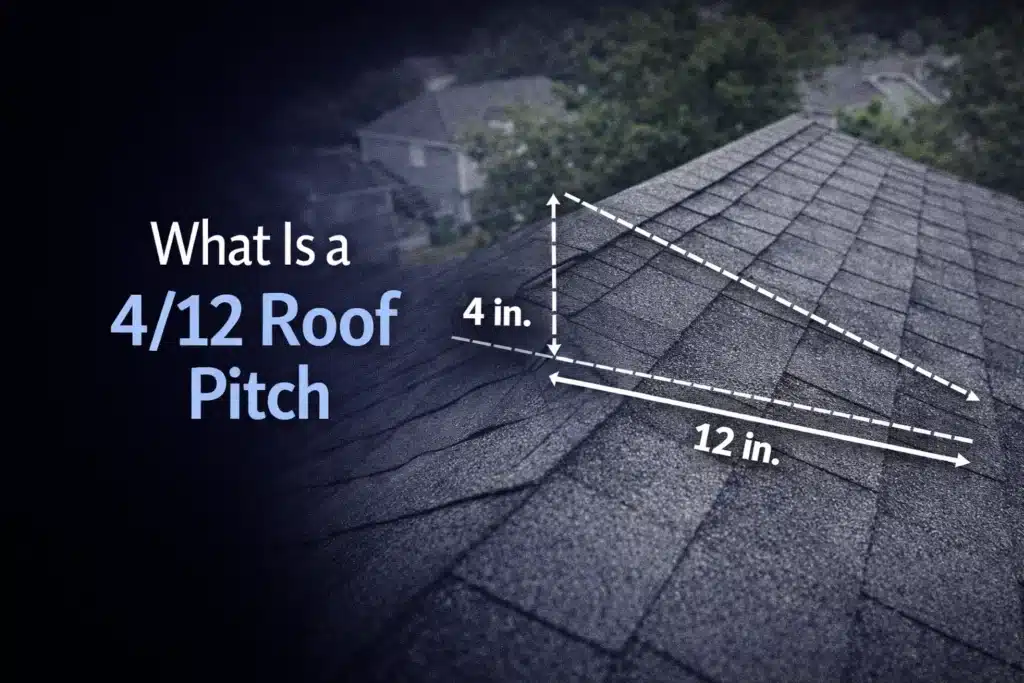
Step 4: Adjust for Roof Pitch
This is where many homeowners make the biggest mistake. Shingles cover the actual sloped surface, not the flat footprint.
A steeper roof has more surface area than it appears from below. That means more shingles, more underlayment, and usually more labor.
Common pitch adjustment idea
You can use a pitch multiplier to get closer to the real roof area. Here is a practical guideline:
| Roof Pitch | Approximate Multiplier |
| 3/12 to 4/12 | 1.05 |
| 5/12 to 6/12 | 1.12 |
| 7/12 to 9/12 | 1.19 |
| 10/12 to 12/12 | 1.30 |
So if your flat total is 1,460 sq ft and your roof is around 6/12 pitch:
1,460 × 1.12 = 1,635.2 sq ft
That is a much more useful number for shingles.
How to estimate pitch if you do not know it
Some homeowners measure pitch from inside the attic or use a pitch gauge app. Others estimate visually, but that can be inaccurate.
If the pitch guess is off, the shingle estimate will be off too. On simple roofs, the difference may be manageable. On large or steep roofs, it can become expensive.
Step 5: Add Waste for Cuts, Valleys, and Mistakes
After pitch adjustment, add waste. This step matters because shingles are not installed with perfect zero-loss efficiency.
Waste comes from:
- starter strips
- ridge caps
- cuts around hips and valleys
- dormers and penetrations
- minor breakage or mistakes
Typical waste allowance
A basic roof may need around 10% waste. A more complex roof may need 12% to 15% or more depending on the layout.
Here is a simple guide:
| Roof Type | Typical Waste Allowance |
| Simple gable roof | 10% |
| Moderate roof with hips/valleys | 12% |
| Complex cut-up roof | 15%+ |
If your pitch-adjusted total is 1,635 sq ft and you add 10% waste:
1,635 × 1.10 = 1,798.5 sq ft
Divide by 100 and you get about 18 squares.
Step 6: Convert Square Footage Into Shingle Bundles
Once you have the final adjusted total, divide by 100 to get roofing squares. Then convert squares into bundles.
Most standard three-bundle shingles require 3 bundles per square, but not every product is the same. Always check the manufacturer packaging.
Simple conversion example
If your roof comes out to 18 squares:
- 18 squares × 3 bundles per square = 54 bundles
That gives you a rough bundle count for field shingles. Ridge caps, starter shingles, underlayment, and other accessories still need separate attention.
This is where product choice matters
Not all shingle systems are identical. Architectural shingles, ridge systems, starter strips, and specialty products can change the total material list.
That is why homeowners comparing options often benefit from reading how to choose the best asphalt shingles before ordering anything.
Common Mistakes When Measuring a Roof for Shingles
Even when the math is simple, a few small mistakes can throw the result off.
Ignoring pitch
This is one of the biggest errors. A flat measurement alone is not enough for real shingle coverage.
Missing small roof sections
Porches, dormers, garage sections, and bump-outs are easy to overlook. Together, they can add a meaningful amount of square footage.
Using too little waste
A roof with valleys, ridges, and cut-up lines usually needs more than the minimum waste allowance.
Assuming all roofs are simple
A basic gable roof is one thing. A roof with multiple sections, flashing details, or aging materials is something else entirely.
If the roof is older and you are already debating repair versus replacement, should I repair or replace my roof is a strong related read.
When DIY Measuring Is Fine and When It Is Not
A homeowner measurement is useful when you want a rough estimate for planning. It can help you understand size, budget range, and whether the project is likely small, medium, or large.
But DIY measuring has limits. It does not tell you whether the roof decking is damaged, whether underlayment needs full replacement, or whether storm wear has changed the scope of the job.
DIY measuring is usually fine for
- rough planning
- ballpark material estimates
- comparing budget scenarios
- understanding roof size before talking to contractors
Professional measuring is better for
- ordering materials
- full roof replacement
- complex roof shapes
- steep or unsafe roofs
- storm-damaged roofs
- insurance-related documentation
This becomes especially important on an asphalt shingle roof where exact material planning affects cost, waste, and installation flow.
How Roof Size Connects to Roof Replacement Cost
Many homeowners asking how to measure my roof for shingles are really trying to understand how much the project may cost.
Roof size is one of the biggest factors in roof replacement pricing, but it is not the only one. Material type, roof pitch, tear-off layers, flashing, underlayment, ventilation, decking repair, and labor all affect the final price.
That is why roof size helps with planning, but not with exact quoting. For that, a contractor still needs to inspect the full roofing system. If cost is your bigger concern, how much does a roof cost is one of the most relevant next reads.
Florida Homes Need a Little Extra Care in Roof Planning
Florida roofs do not just deal with sun. They also face humidity, driving rain, wind uplift, and storm exposure. That means roof measurement is only one part of the bigger roofing decision.
A roof may measure the same size as another home and still need a different scope because of storm wear, flashing condition, or material performance in Florida weather. That is why measurement should support the decision, not replace inspection and expert review.
FAQ
How do I calculate how many shingles I need for my roof?
Measure each roof section, calculate square footage, adjust for pitch, add waste, then divide by 100 to get roofing squares. After that, convert squares into bundles based on the shingle product.
What is a roofing square?
A roofing square equals 100 square feet of roof area.
Can I measure my roof from the ground?
You can get a rough estimate from the home footprint, but it may miss overhangs, pitch, and smaller roof sections. It is useful for planning, not perfect ordering.
How much waste should I add for shingles?
A simple roof often needs around 10% waste. More complex roofs may need 12% to 15% or more.
Do I need to measure roof pitch for shingles?
Yes. Pitch affects actual roof surface area, so skipping it can leave you short on materials.
How many bundles of shingles are in a square?
Many standard shingles use 3 bundles per square, but always verify the product specifications before ordering.
Can I use the house square footage to estimate the roof size?
Only as a rough starting point. House square footage does not automatically match roof square footage because of pitch, shape, and overhangs.
When should a roofer measure the roof instead of me?
A roofer should confirm measurements for full replacement, complex roofs, steep roofs, or any project where exact material ordering matters.
Get an Accurate Roof Measurement Before You Order Materials
If you want more than a rough guess, Rhino Roofing Orlando can help. We can inspect the roof, measure the real scope, and explain what your shingle project actually needs before you spend money in the wrong place. To get clear next steps, schedule a roof inspection, request an estimate, or contact Rhino Roofing Orlando.
Conclusion
How to measure my roof for shingles starts with basic math, but a reliable number takes more than length and width alone. You need to break the roof into sections, calculate square footage, adjust for pitch, and add waste for cuts and layout.
That process is useful for planning, but it still has limits. If the roof is steep, complex, storm-damaged, or close to replacement age, the smartest move is to let a roofer confirm the full measurement and project scope before materials are ordered.