
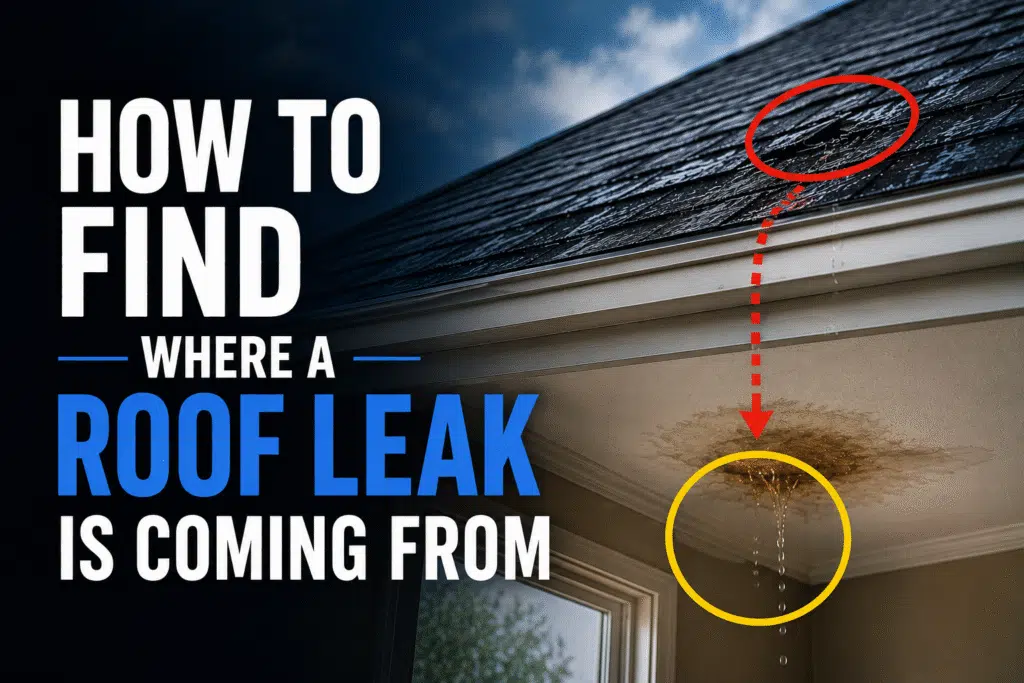
Finding a roof leak is not always as simple as looking directly above the ceiling stain. Water can enter through one part of the roof, travel along rafters or decking, and show up several feet away inside the home.
If you are wondering how to find where a roof leak is coming from, the best starting point is to check the attic, inspect common roof leak areas, look for storm damage, and document where water appears during or after rain. A professional roof inspection may still be needed because roof leaks can be tricky to trace safely and accurately.
How to Find Where a Roof Leak Is Coming From? Quick Answer
To find where a roof leak is coming from, start inside the home by locating ceiling stains, wet insulation, attic moisture, or dripping water. Then trace the water path upward in the attic and check common exterior leak areas such as shingles, flashing, valleys, vents, skylights, pipe boots, gutters, and roof edges.
As we often explain to homeowners, the visible stain is not always directly below the leak source. Water can travel before it drips, especially during heavy rain or wind-driven storms. That is why a full roof inspection is usually the safest way to confirm the real source.
Why Roof Leaks Are Hard to Find
Roof leaks can be difficult because water rarely moves in a straight line.
A small opening around a vent, flashing joint, or damaged shingle may allow water in. Once inside, that water can travel along wood framing, underlayment, insulation, or electrical penetrations before appearing on the ceiling.
The stain may not be under the leak
A ceiling stain in the bedroom could come from a roof vent several feet away. A leak near a chimney could travel along roof decking before dripping into the attic.
That is why guessing from the inside alone can lead to the wrong repair.
Heavy rain makes leak tracing harder
During heavy rain, multiple areas may get wet at the same time. This can make it harder to tell whether the leak is from shingles, flashing, gutters, or another roof component.
Homeowners dealing with rain-related leaks may also review why is my roof leaking after heavy rain.
Step 1: Start Inside the Home
Before going near the roof, inspect the interior safely.
Look for visible water signs
Check for:
- ceiling stains
- peeling paint
- bubbling drywall
- dripping water
- damp carpet
- musty smells
- water near light fixtures
If water is near electrical fixtures, avoid touching the area and call a professional.
Mark the leak location
Use painter’s tape or take photos to document where water appears.
This helps a roofer compare interior damage with the roof layout above.
Step 2: Check the Attic If Safe
The attic is often the best place to trace a roof leak from inside the home.
Only enter the attic if it is safe, dry, and properly accessible.
Look for moisture trails
In the attic, check for:
- wet insulation
- dark stains on wood
- damp rafters
- water trails
- mold-like spots
- daylight through the roof
- rusted nails
Follow the water marks upward whenever possible. The highest wet point often gets you closer to the leak source.
Use a flashlight
A bright flashlight can help reveal moisture on decking, rafters, and around roof penetrations.
Look carefully near vents, chimneys, skylights, and valleys.
Step 3: Check Common Roof Leak Sources
Most roof leaks come from specific weak points.
Damaged or Missing Shingles
Missing, cracked, lifted, or curled shingles can allow water beneath the roof surface.
Shingle damage signs
From the ground, look for:
- shingles in the yard
- dark exposed roof patches
- uneven roof sections
- curled shingle edges
- granules near downspouts
If shingles are missing, homeowners can review can missing shingles be replaced.
Flashing Around Roof Penetrations
Flashing is one of the most common leak sources.
It protects areas where the roof meets walls, chimneys, vents, skylights, or other openings.
Common flashing leak areas
Check around:
- chimneys
- skylights
- vent pipes
- wall intersections
- roof valleys
- dormers
Loose, cracked, rusted, or poorly sealed flashing can allow water inside during storms.
This type of issue often requires professional roof repair.
Pipe Boots and Roof Vents
Pipe boots seal plumbing vent pipes where they pass through the roof.
Over time, rubber boots can crack from Florida heat and UV exposure.
Signs of pipe boot leaks
Pipe boot leaks often show up as:
- ceiling stains near bathrooms
- attic moisture around vent pipes
- cracked rubber around roof pipes
- water stains on nearby decking
A pipe boot leak may be small, but it can cause major interior damage if ignored.
Roof Valleys
Roof valleys carry large amounts of water because two roof slopes meet there.
During heavy rain, valleys become high-pressure drainage areas.
Valley leaks may come from
- damaged valley flashing
- debris buildup
- cracked shingles
- worn underlayment
- poor installation
Valley leaks can spread quickly because so much water flows through that section.
Skylights and Chimneys
Skylights and chimneys are common leak points because they interrupt the roof surface.
Possible causes include
- failed sealant
- cracked flashing
- poor installation
- damaged counterflashing
- worn skylight gaskets
- cracks around chimney masonry
If the leak appears near a skylight or fireplace, these areas should be inspected carefully.
Step 4: Inspect Gutters and Roof Edges
Sometimes roof leaks are connected to drainage problems.
Clogged gutters can force water to back up under shingles or overflow into fascia and soffit areas.
Drainage issues to check
Look for:
- clogged gutters
- overflowing downspouts
- sagging gutter sections
- water stains on fascia
- debris packed near valleys
- roof edge rot
If drainage is causing repeated problems, gutter installation or gutter repair may help protect the roof edge.
Step 5: Look for Storm Damage
Florida storms can create leaks that are not obvious from the ground.
Wind, hail, and flying debris may damage shingles, flashing, underlayment, and roof penetrations.
Storm damage clues
After severe weather, look for:
- missing shingles
- dented gutters
- loose flashing
- branches on the roof
- granules in gutters
- roof debris in the yard
- new ceiling stains
Homeowners should also review what to do after hail, wind, or rain damage if the leak started after a storm.
Step 6: Avoid Unsafe Roof Walking
Walking on a roof can be dangerous, especially after rain.
Wet shingles, tile, metal roofing, and steep slopes can create serious fall risks.
Do not climb onto the roof if
- the roof is wet
- the pitch is steep
- storm damage is present
- shingles are loose
- you do not have proper safety equipment
- there are power lines nearby
A roof leak is frustrating, but safety comes first.
Can You Find a Roof Leak With a Water Test?
Sometimes roofers use a controlled water test to locate a leak.
This usually involves spraying one roof section at a time while another person checks the attic or interior.
Why water testing should be careful
Too much water can worsen interior damage if the leak source is not controlled.
Water testing should be done slowly, section by section, and ideally by a professional.
Roof Leak Checklist for Homeowners
Here is a simple checklist to help narrow down the source:
| Area to Check | What to Look For |
| Ceiling | Stains, bubbling paint, dripping |
| Attic | Wet insulation, dark decking stains |
| Shingles | Missing, cracked, curled, lifted areas |
| Flashing | Loose, rusted, cracked, open seams |
| Vents | Cracked pipe boots, water stains |
| Valleys | Debris, damaged shingles, heavy water flow |
| Gutters | Overflowing, clogged, sagging sections |
| Roof edges | Fascia stains, soffit moisture |
| Storm areas | Debris, dents, new damage |
Takeaway:
The leak source may be several feet away from where water appears inside, so follow the water path carefully and inspect the most common weak points.
When a Roof Leak Needs Professional Inspection
Some leaks are simple. Others are hidden and require professional diagnosis.
Call a roofer if
- the leak keeps returning
- water is near electrical areas
- the roof is steep or unsafe
- shingles are missing after a storm
- attic insulation is wet
- ceiling stains are spreading
- you cannot find the source
- multiple areas are leaking
A professional inspection can determine whether the roof needs repair, partial replacement, or full replacement.
Homeowners unsure about severity may also review when does a roof leak need full replacement.
Can a Roof Leak Be Fixed From Inside?
An inside fix may help temporarily, especially during active rain.
However, most roof leaks need exterior repair because the water is entering from the outside roofing system.
Inside fixes are usually temporary
Interior sealant, buckets, towels, or attic patches may control damage for a short time, but they do not usually solve the source.
Homeowners can learn more from can a roof leak be fixed from the inside.
Need Help Finding a Roof Leak in Orlando?
Roof leaks are not always easy to trace, and guessing can lead to the wrong repair. Rhino Roofing Orlando can inspect your roof, check the attic, locate the leak source, and explain the right repair before the damage spreads. Schedule a roof inspection or contact Rhino Roofing Orlando for professional roof leak help.
Conclusion
So, how to find where a roof leak is coming from? Start by checking interior stains, attic moisture, and visible water trails. Then look at common roof leak sources such as shingles, flashing, vents, valleys, skylights, gutters, and storm-damaged areas.
Because water can travel before showing up indoors, the visible leak is not always directly below the source. A professional inspection is the safest and most reliable way to find the real problem and stop the leak properly.
FAQ Section
How do I find where a roof leak is coming from?
Start inside by locating stains or drips, then check the attic for water trails. After that, inspect common exterior areas like shingles, flashing, vents, valleys, skylights, and gutters.
Is the roof leak directly above the ceiling stain?
Not always. Water can travel along rafters, decking, insulation, or framing before dripping into the ceiling.
What is the most common cause of roof leaks?
Common causes include damaged shingles, failing flashing, cracked pipe boots, clogged gutters, valleys, and storm damage.
Can clogged gutters cause a roof leak?
Yes. Clogged gutters can cause water to back up under roof edges and damage fascia, soffits, or shingles.
Can I find a roof leak without climbing on the roof?
Yes. Many clues can be found from inside the home, attic, yard, and ground-level visual inspection.
Should I use a hose to find a roof leak?
A controlled water test can help, but it should be done carefully because too much water can worsen the leak.
When should I call a roofer for a leak?
Call a roofer if the leak is active, recurring, storm-related, difficult to trace, or causing interior damage.
Can roof leaks come from vents or flashing?
Yes. Vents, flashing, skylights, chimneys, and valleys are some of the most common roof leak points.

Romail Shah is a content strategist and web authority expert who works with Rhino Roofing Orlando’s licensed roofing team to create accurate, trustworthy guides on residential and commercial roofing in Central Florida. His article reflects real expertise and Florida-specific roofing standard