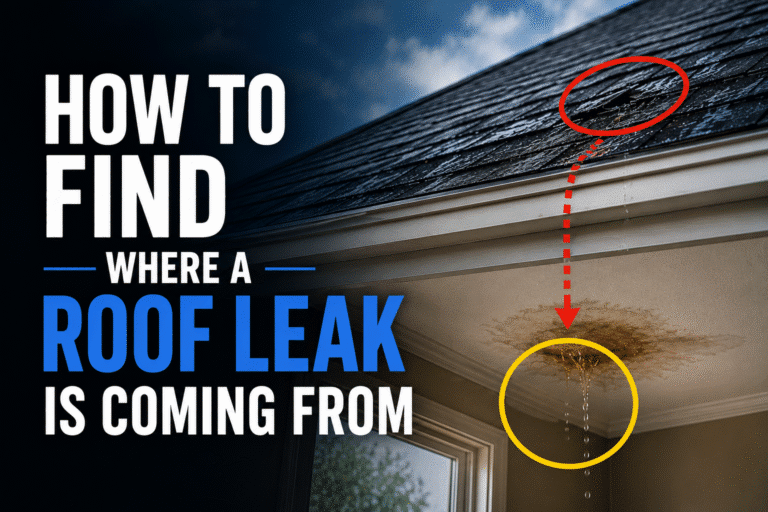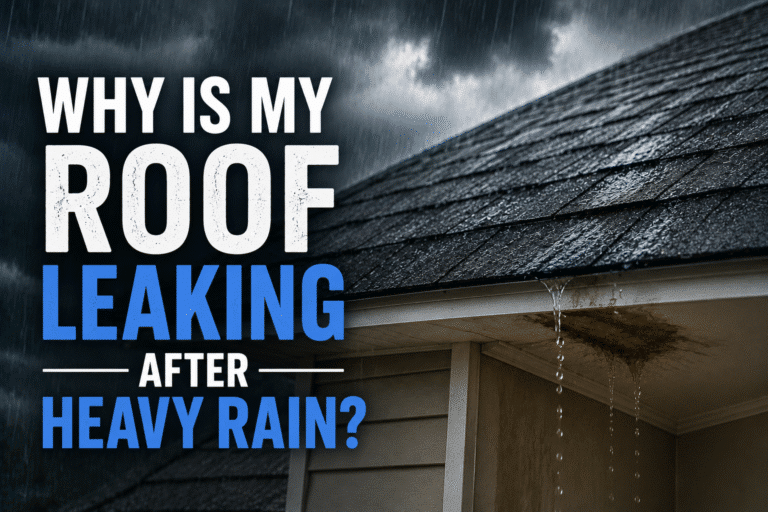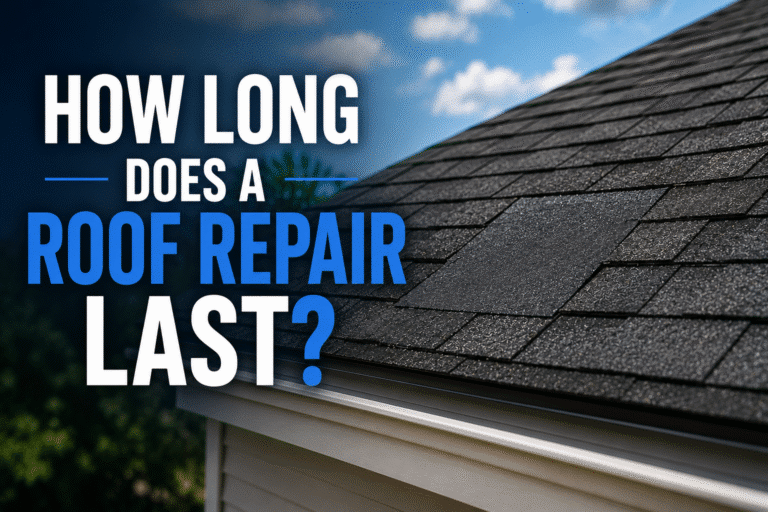
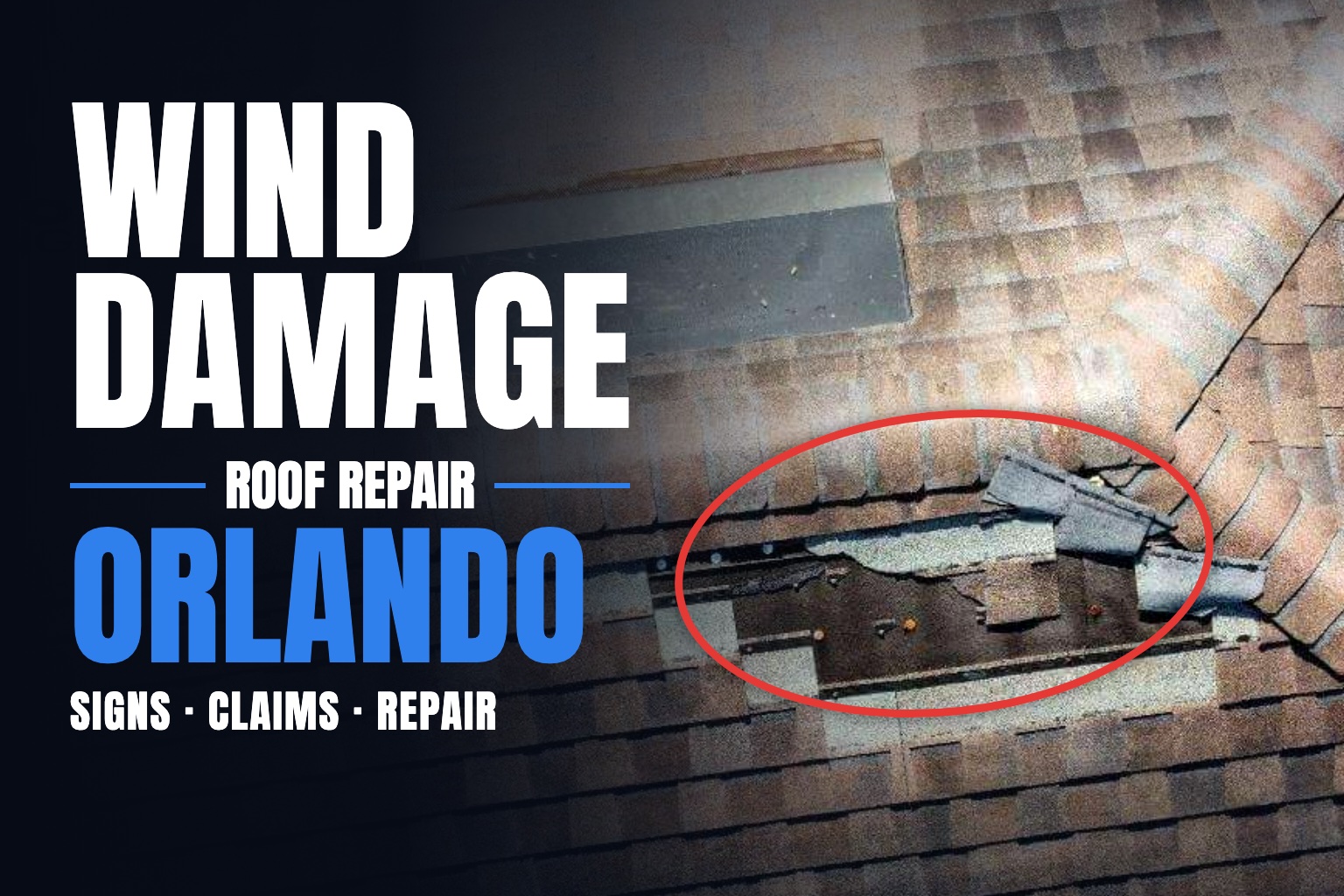
A strong summer thunderstorm or a passing hurricane can leave your roof looking fine from the driveway while shingles have quietly lost their seal, tiles have shifted, or flashing has pulled loose. That hidden damage is what turns into a ceiling stain three weeks later.
This guide explains wind damage roof repair for Orlando and Central Florida homeowners: how to spot wind damage on shingle, tile, metal, and flat roofs, what to do in the first 48 hours, how Florida insurance rules affect your claim, and how to decide between a repair and a full replacement. It is written by the team at Rhino Roofing, a Longwood roofing contractor with more than 35 years in Central Florida.
Wind Damage Roof Repair: Quick Answer
Wind damage roof repair means fixing the parts of a roof that high winds have lifted, torn, or loosened, usually missing or creased shingles, displaced or cracked tiles, loose flashing, damaged ridge caps, and lifted metal panels or flat-roof edges. Repair is usually the right call when the damage is limited to a few areas and the roof is otherwise in good shape. Replacement makes more sense when damage is widespread, the roof is near the end of its life, or matching materials are no longer available.
In Florida, report storm damage to your insurer promptly. For damage from a hurricane or windstorm, Florida law gives you one year from the date of loss to file a new claim, so do not wait for a leak to appear before having the roof checked. A free roof inspection after any major storm is the simplest way to find damage early.
How Wind Damages a Roof
Wind does not push straight down on a roof. As it flows over and around a home, it creates suction (uplift) that pulls upward on roofing materials. That uplift is strongest at the corners, edges, eaves, rakes, and ridge, which is why wind damage almost always starts there and works inward.
Once wind gets under one loose edge, each gust acts like a lever. A shingle that has lost its adhesive seal starts to flap, the nails loosen, and the next gust can tear it off completely. Flying debris such as palm fronds, branches, and pieces of a neighbor’s roof add impact damage on top of the uplift.
How fast does wind need to be to damage a roof?
There is no single number, because it depends on the roof’s age, materials, and how it was installed. For reference:
- The National Weather Service classifies a thunderstorm as severe when it produces winds of 58 mph or more.
- Hurricane-force winds start at 74 mph.
- Asphalt shingles are sold with wind ratings from standard tests. ASTM D3161 Class F shingles are tested at 110 mph, and ASTM D7158 Class H shingles are rated for 150 mph.
Those ratings apply to a properly installed, well-sealed roof. An older roof with brittle shingles, failed seal strips, or poor nailing can lose shingles in ordinary thunderstorm gusts well below its rating.
Why Central Florida roofs take a beating
Orlando does not need a direct hurricane hit to see roof damage. Our summer pattern of afternoon thunderstorms brings sudden downburst winds almost every week from June through September, and the region has been crossed by strong storms such as Hurricane Charley in 2004, Hurricane Ian in 2022, and Hurricane Milton in 2024. Add intense sun that dries out shingles and seal strips, and many roofs in Longwood, Orlando, and Seminole County are more vulnerable to wind than their age suggests.
What Does Wind Damage Look Like on a Roof?
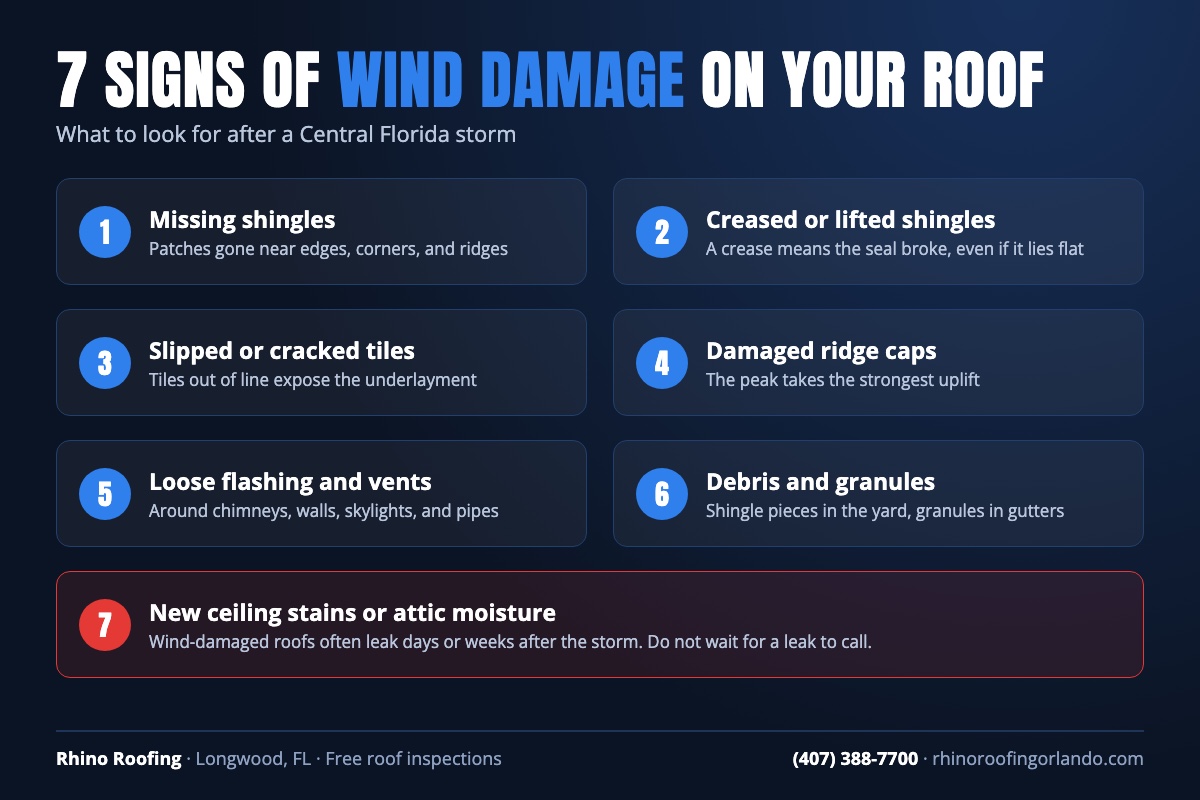
Wind damage looks different on each type of roof. Here is what to look for, starting with the most common roof in Central Florida.
Asphalt shingle roofs
- Missing shingles, often in patches near edges, ridges, and corners, sometimes exposing black underlayment or bare wood decking.
- Creased or folded shingles. A horizontal crease across a shingle means it was lifted and bent back. Even if it lies flat again, the crease is a weak point and the seal is broken.
- Lifted or curling edges that you can see as uneven shadow lines on the roof.
- Damaged ridge caps along the peak, one of the most exposed parts of the roof.
- Granules piled in gutters or at downspouts after a storm, a sign of scuffing and impact.
- Shingle pieces in the yard. If you find them, the roof has lost material somewhere.
If shingles are missing, our article on whether missing shingles can be replaced covers what makes a spot repair possible.
Tile roofs
- Tiles that have slipped out of line, lifted, or slid down the roof.
- Cracked or broken tiles, often from debris or from tiles knocking against each other.
- Loose or missing ridge and hip tiles.
- Exposed underlayment where a tile is gone. On a tile roof, the underlayment is the real waterproof layer, so an open spot can leak quickly. See our page on tile roof underlayment replacement for when that layer needs attention.
Metal roofs
- Panels with lifted seams or edges, especially at the eaves and rakes.
- Loose, backed-out, or missing fasteners on exposed-fastener systems.
- Bent trim, ridge caps, or gable flashing.
Flat and low-slope roofs
- Membrane peeling or “ballooning” at the perimeter and corners.
- Loose edge metal or coping.
- Tears and punctures from wind-blown debris.
On every roof type
- Loose or lifted flashing around chimneys, walls, skylights, and valleys. Flashing is a common hidden leak point after wind, and our roof flashing repair page explains how it is fixed.
- Damaged vents, pipe boots, and soffits.
- Bent or pulled-away gutters and fascia.
- Inside the home: new ceiling stains, damp insulation in the attic, or daylight showing through the roof decking.
Real Wind Damage Roof Repairs From Our Crews
These are before and after photos from Rhino Roofing jobs in Central Florida.

Above: a shingle roof in Seminole County with a strip of shingles missing just below the ridge, the classic pattern of wind damage, leaving the underlayment exposed. The crew replaced the missing shingles so the repaired area matches the rest of the roof.
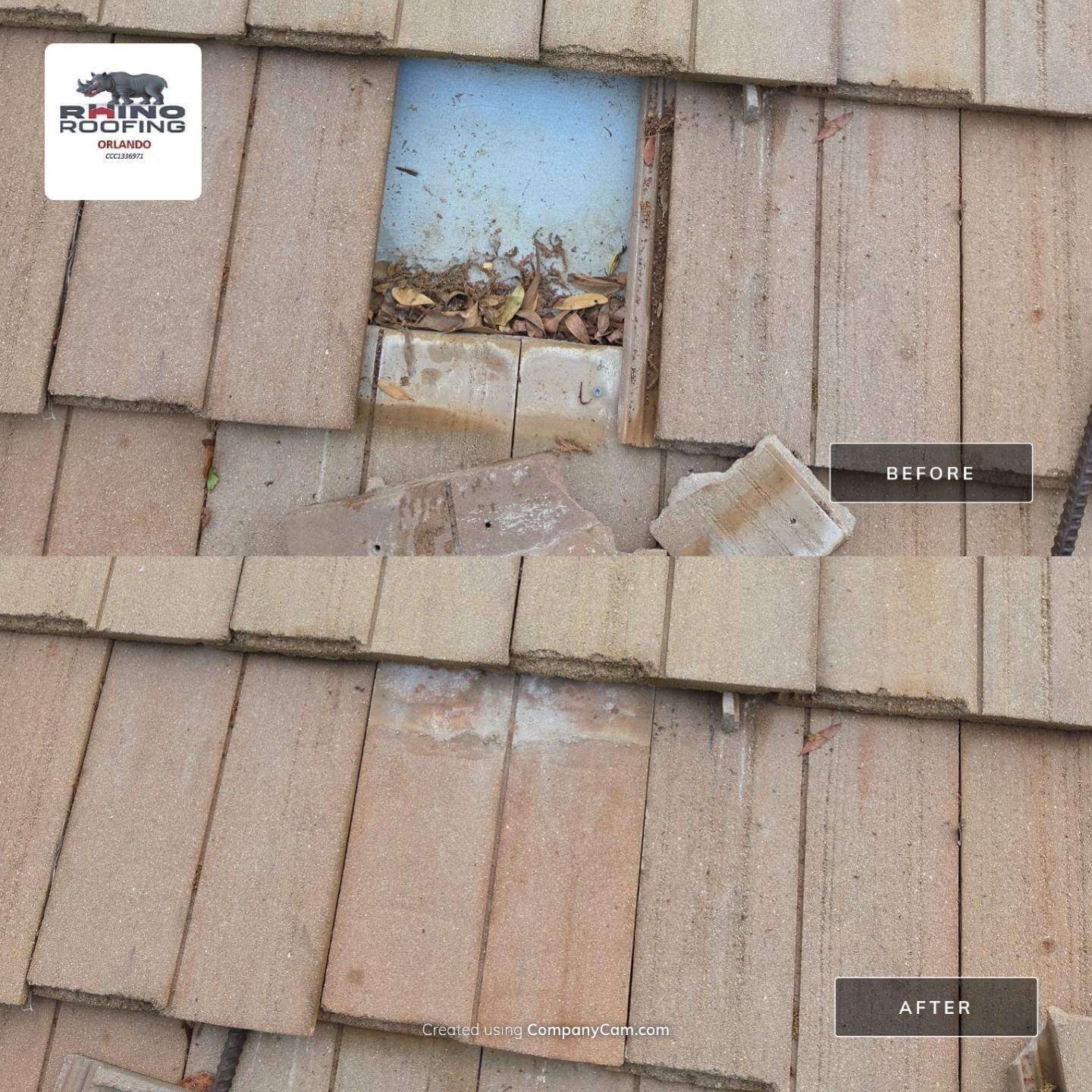
Above: a concrete tile roof with broken and displaced tiles that left the underlayment open to rain and debris. The damaged tiles were replaced and set back in line with the rest of the roof.
What to Do After Wind Damages Your Roof
The first 48 hours matter most, both for protecting your home and for your insurance claim.
- Stay safe and stay off the roof. Wet, damaged roofs are slippery and may be weaker than they look. Watch for downed power lines and hanging limbs.
- Inspect from the ground. Walk around the house and look for missing shingles or tiles, debris on the roof, bent gutters, and roofing material in the yard. Binoculars help.
- Check inside. Look at ceilings, especially near exterior walls, and check the attic with a flashlight for drips, wet insulation, or daylight.
- Document everything. Take date-stamped photos and video of the roof, the yard, and any interior damage before anything is moved or cleaned up. Note the date of the storm.
- Prevent further damage. If the roof is open or leaking, have it tarped as soon as it is safe. Most policies expect you to take reasonable steps to protect the home, and you should keep the receipts. See our emergency roof tarping service and what goes into roof tarping in Orlando.
- Get a professional roof inspection. A roofer can find creased shingles, broken seals, and loose flashing that you cannot see from the ground.
- Contact your insurance company if the inspection confirms storm damage, and keep a record of every call, email, and claim number.
For a broader checklist that also covers hail and heavy rain, read what to do after hail, wind, or rain damage. If the roof is actively leaking right now, go straight to our emergency roof repair team.
Does Insurance Cover Wind Damage to a Roof in Florida?
In most cases, yes. Standard Florida homeowners policies generally cover sudden wind damage, such as shingles or tiles torn off in a storm, unless windstorm coverage has been excluded from your policy. What insurance usually does not cover is wear and tear, old age, or damage caused by poor maintenance. That is why the condition of your roof before the storm, and good documentation after it, matter so much.
Florida claim deadlines
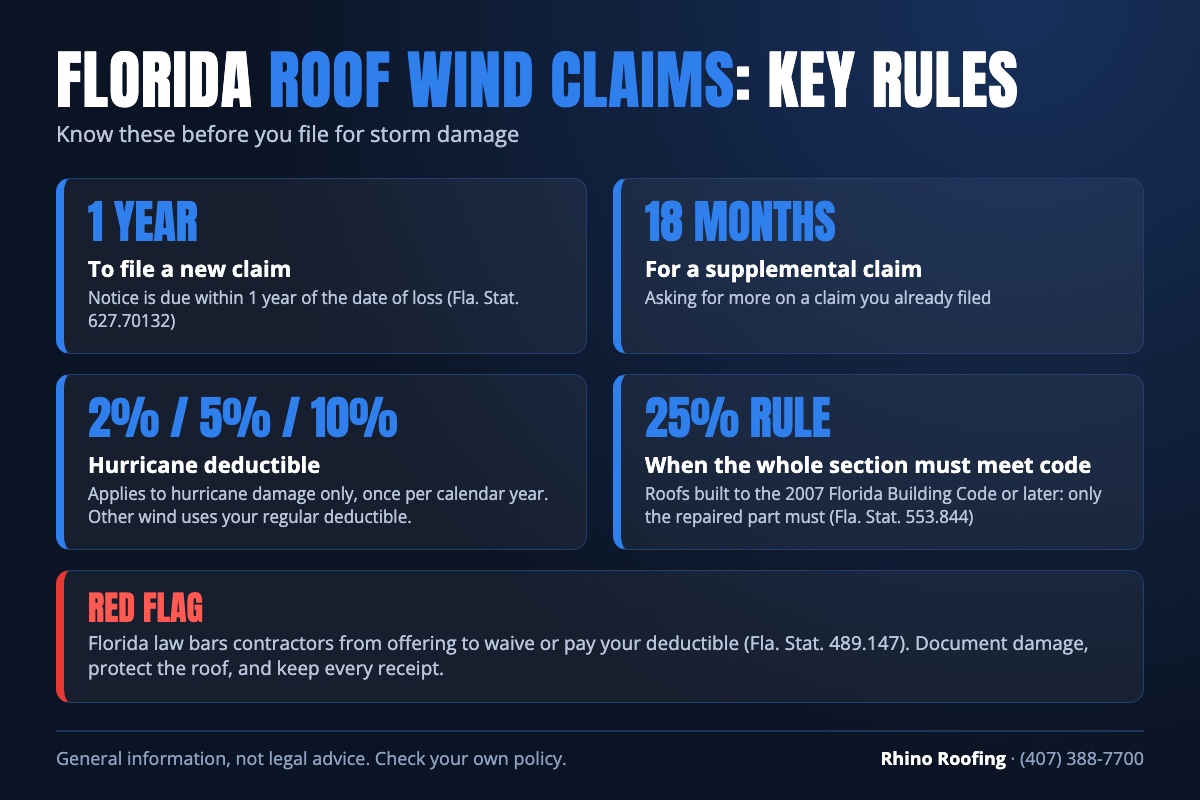
Under Florida Statute 627.70132, a new or reopened property claim must be reported to your insurer within one year after the date of loss. A supplemental claim (asking for more money on a claim you already filed) must be made within 18 months. For hurricanes and windstorms, the date of loss is the date the hurricane made landfall or the storm was verified by NOAA. Older articles online still mention three years, but that is no longer the rule.
Hurricane deductible vs. regular deductible
Many Florida policies have two deductibles. The hurricane deductible is usually a percentage of your dwelling coverage, commonly 2%, 5%, or 10%, and it applies only to damage from a named hurricane during the window that starts when the National Hurricane Center issues a hurricane watch or warning for any part of Florida and ends 72 hours after the last one ends. Florida law also limits it to once per calendar year for personal residential policies.
Damage from a regular thunderstorm, a tropical storm outside that window, or a tornado falls under your all other perils (AOP) deductible, which is often a flat dollar amount. Check your declarations page so you know which applies before you file.
Red flags to avoid
Florida law (Statute 489.147) bars contractors from offering to waive or pay your deductible or giving gifts and incentives for filing a claim. Florida also no longer allows assignment of benefits on residential property policies issued on or after January 1, 2023, so you stay in control of your own claim. Be cautious of anyone who knocks on your door after a storm promising a “free roof.”
Insurance policies vary. Read your own policy, and talk to your insurance agent or a licensed public adjuster if you have coverage questions.
Repair or Replace: How Much Wind Damage Means a New Roof?
There is no fixed percentage that automatically means replacement. The decision usually comes down to these factors:
- How widespread the damage is. A few missing shingles on one slope is usually a repair. Creased and unsealed shingles across several slopes often point to replacement, because the whole roof has lost its wind resistance.
- The age and condition of the roof. A newer roof is almost always worth repairing. A roof near the end of its life may not hold a repair well. Our guide on when a roof is too old to repair goes deeper.
- Whether materials can be matched. Discontinued shingles or tiles can make a patch stand out. Florida Statute 626.9744 requires insurers to make reasonable repairs to adjoining areas so the repair is uniform when replacement items do not match in quality, color, or size, under policies that settle on repair or replacement cost.
- The condition of the decking and underlayment under the damaged area.
The Florida “25% rule” explained
The Florida Building Code has long said that if more than 25% of a roof section is repaired, replaced, or recovered within a 12-month period, the entire roof section must be brought up to current code. Since 2022, Florida Statute 553.844(5) carves out an important exception: if your roof was built, repaired, or replaced under the 2007 Florida Building Code or later, only the portion being repaired must meet current code. In practice, that means homeowners with roofs installed in roughly the last 15 years are less likely to be pushed into a full replacement by the 25% rule alone. Our article on whether you can replace only part of a roof explains how partial replacements work.
For budgeting, see our roof repair cost guide for Orlando and, if replacement is on the table, our new roof cost guide and roof replacement page.
How Wind Damage Roof Repair Works
A proper wind damage repair fixes the cause, not just the hole you can see.
- Inspection. We check the whole roof, not just the obvious spot, including edges, ridges, flashing, and the attic. Where it helps, we use a drone and thermal scan to find hidden moisture and damage without walking every slope.
- Temporary protection. If the roof is open, it is tarped right away to stop water getting in.
- Repair. Damaged shingles or tiles are removed, the underlayment and decking underneath are checked and replaced if needed, and new material is installed and sealed. Loose flashing, ridge caps, and vents are refastened or replaced.
- Final check. The repaired area is checked against the rest of the roof, and the job site is cleaned up.
Can you repair wind damage yourself?
Replacing a single shingle is something a confident homeowner can do on a low, dry roof, but most wind damage repairs are best left to a licensed roofer. Damage is often wider than it looks, creased shingles need replacing even when they lie flat, and a poorly sealed patch can fail in the next storm. Working on a roof is also genuinely dangerous. If you are thinking about a quick patch, read whether it is better to patch a roof or replace it first.
How to Make Your Roof More Wind Resistant
- Choose high-wind rated materials when you repair or replace. Look for shingles with an ASTM D3161 Class F or ASTM D7158 Class H rating.
- Insist on correct installation. Wind ratings depend on proper nailing, starter strips at the eaves and rakes, and a good seal.
- Keep up with maintenance. Small issues like a lifted shingle or loose flashing are cheap to fix before storm season and expensive after it. Our Rhino Care Club maintenance plan includes a 17-point roof check-up, debris removal, and 10% off repairs.
- Trim trees that overhang the roof and remove dead limbs before hurricane season.
- Clean gutters so water drains and gutters do not pull away in high winds.
- Get an inspection before and after storm season, especially if your roof is more than 10 years old.
For more on why some roofs fail completely in big storms, read how roofs get blown off during a wind storm.
Wind Damage Roof Repair in Orlando and Longwood
Rhino Roofing (formerly Russ Noyes Roofing) has been repairing Central Florida roofs for more than 35 years from our shop at 385 Commerce Way in Longwood, FL. We are a Diamond level Atlas Pro Contractor and a Westlake Preferred Pro Contractor, licensed in Florida (CCC1336971), and rated 4.9 stars from more than 350 Google reviews.
We repair wind damage on shingle, tile, metal, and flat roofs across Orlando, Longwood, and Seminole County. If a storm has passed through and you are not sure whether your roof was damaged, book a free roof inspection. You will get a straight answer on what needs fixing now and what can wait.
Call (407) 388-7700 or request your free inspection online. We are open Monday to Friday 8:00 AM to 8:00 PM and Saturday and Sunday 8:00 AM to 6:00 PM. Learn more about our roof repair services.
Wind Damage Roof Repair FAQs
How do I know if my roof has wind damage?
Look for missing, creased, or lifted shingles, displaced or cracked tiles, damaged ridge caps, loose flashing, granules in the gutters, roofing debris in the yard, and new ceiling stains inside. Because creased shingles and broken seals are hard to see from the ground, a professional inspection after a major storm is the most reliable way to know.
Does homeowners insurance cover wind damage to a roof?
Most Florida homeowners policies cover sudden wind damage unless windstorm coverage was excluded. They usually do not cover wear and tear or damage from poor maintenance. Your deductible depends on whether the damage came from a declared hurricane or another windstorm.
How long do I have to file a wind damage roof claim in Florida?
Florida law requires notice of a new or reopened claim within one year of the date of loss, and supplemental claims within 18 months. Report damage as soon as you find it.
Can a roof with wind damage be repaired instead of replaced?
Yes. If the damage is limited to a few areas, the roof is in good overall condition, and matching materials are available, a repair is often the best value. Widespread damage on an older roof is more likely to need replacement.
How much wind damage is needed to replace a roof?
There is no single threshold. Insurers and roofers look at how widespread the damage is, the roof’s age and condition, and whether a repair can match. Florida’s 25% rule can also require a full roof section to meet current code, unless the roof was installed under the 2007 Florida Building Code or later.
Can wind damage cause a roof leak later?
Yes. Shingles that have lost their seal or been creased may stay in place but let wind-driven rain underneath. Leaks can show up days or weeks after the storm, which is why prompt inspection matters.
Should I get a roof inspection after every storm?
Not after every rain shower, but it is worth having the roof checked after any hurricane, tropical storm, or severe thunderstorm with strong gusts, and any time you find shingles or tiles on the ground.